


Web hosting diagnostics
Updated on
Diagnostics
Apart from the WordPress Webmastering plan, in which we provide help with debugging and diagnosing your site, diagnosing how a site works is the webmaster’s responsibility. In case of an error, you need to check the domain’s logs, deactivate the plugins or themes related to the error, check which change may have caused the malfunction, find the PHP files causing errors, update your CMS, reinstall manually if necessary, and so on.
Using logs
A web server’s logs (history of requests and errors) are necessary for any website administration. They let you check and understand any errors that occur when the site is visited or run.
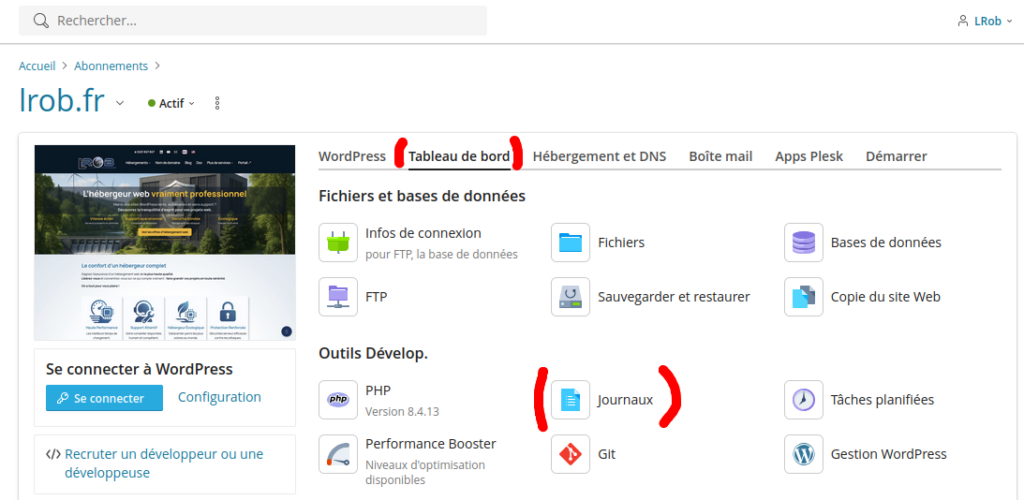
You can view these logs through the Plesk control panel, under the domain concerned in the “Dashboard” tab, then “Logs”. You can also filter these logs using the free-text fields, as well as the drop-down menu at the top right.
Apache status and error codes
Web servers generally display an error code when something is not working. These codes can quickly point you to the cause of the problem, but for more detail, you should always make a habit of checking the site’s logs.
Error 500
A 500 error means that your site’s PHP code could not be run correctly. These errors are therefore generally a webmastering matter and not a hosting one.
The most common causes:
- Your code calls a function that does not exist in the PHP version chosen for the hosting
- One or more scripts contain code errors
- Your code takes too long to run and exceeds max_execution_time (timeout), or is too heavy and exceeds memory_limit.
RSA certificate
The error looks like this:
Warning AH01909: RSA certificate configured for domain.tld:443 does NOT include an ID which matches the server name
This simply means that your site does not have a valid certificate to be displayed over HTTPS. To learn more, see TLS encryption.
ModSecurity
ModSecurity is a web application firewall that blocks dangerous requests made to your site. Some false positives may be observed, in particular with WordPress and the various “builders” that send very long requests to save their settings.
The error looks like this: [client 192.168.1.128] ModSecurity: [file "/etc/httpd/conf/modsecurity.d/rules/tortix/modsec/50_plesk_basic_asl_rules.conf"] [line "2242"] [id "33340748"] [rev "2"] [msg "Protected by Atomicorp.com Basic Non-Realtime WAF Rules: Generic Path Recursion denied"] [severity "CRITICAL"] Access denied with code 403 (phase 2). Pattern match […]
To disable this specific protection:
- Note the number in the [id ""] field, here in the example: 33340748
- In Plesk, under your domain, click “Web Application Firewall”
- In the “Security rule ID” field, enter the rule number to disable
- If you have several rules to enter, put one rule per line
- Click “OK” to confirm
Your LRob performance hosting fully satisfies you. Sleep soundly with our Webmastering plans, monitoring and diagnostics included.